What Is Confluence in Trading and How Do You Combine Signals Without Overloading a Setup?
You can order the same kind of articles for your own video to boost it on YouTube and Google. Just message the Telegram bot @sat_sit_bot. Articles with your video embedded are written and posted by the bot itself — on popular topical sites (no ads). Free trial — 50 articles.
· based on the channel TJR
Key takeaways
- Confluence is the overlap of two or more independent signals — structure, liquidity, imbalance, session timing — pointing to the same trade direction.
- More confluences do not automatically mean a better trade: each added condition cuts the number of setups and can turn a clean plan into paralysis.
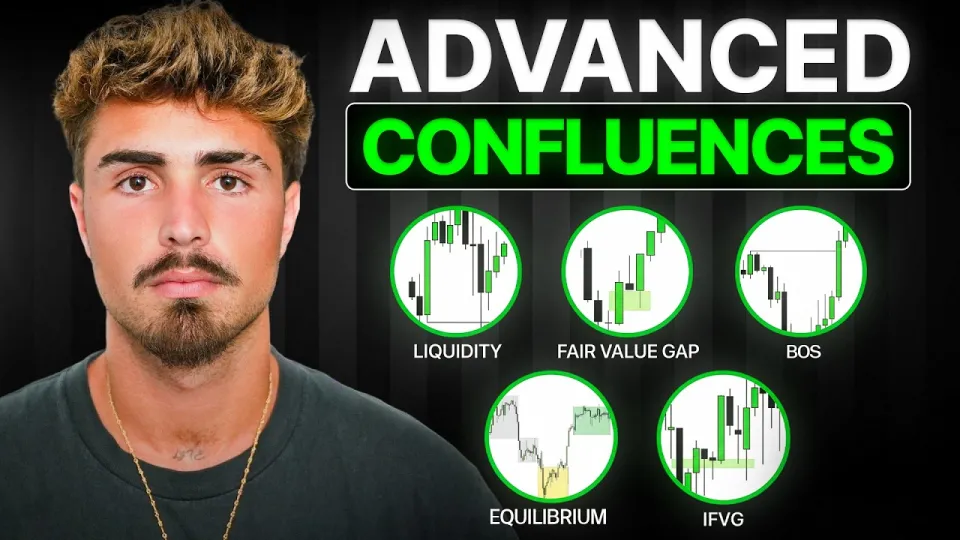
- TJR's 18-minute breakdown on the channel covers liquidity, fair value gaps, inverse FVGs, equal highs and lows, and breaks of structure as the core building blocks.
- A confluence only counts if it is defined in advance with a rule you can check mechanically, not interpreted after the entry.
- Risk parameters — position size, stop placement and reward-to-risk — stay fixed regardless of how many confluences a setup has.
Confluence in trading is the practice of requiring several independent signals to agree before you take a position, so that one chart reading alone never justifies a trade. Instead of acting on a single pattern, you wait for structure, liquidity and price imbalance to point the same way. If you want a structured walkthrough of the full toolkit, TJR's trading blueprint lays out the system behind these ideas.
The concept matters because most losing trades are not caused by a bad pattern — they are caused by a pattern taken in the wrong context. A fair value gap means little in the middle of a range; a break of structure means little against a higher-timeframe trend. Confluence is the filter that turns isolated observations into a repeatable decision.
What trading confluence actually means in practice
A confluence is a confirmation that is logically independent from the first signal, not a second version of it. Two moving averages crossing and a MACD histogram flipping are the same information drawn twice; a liquidity sweep followed by a displacement candle through a fair value gap is two different pieces of evidence.
The practical test is simple: if you removed the first signal, would the second one still tell you something new about where price is likely to go? If the answer is no, you have redundancy, not confluence. Traders who stack correlated indicators often believe they are being careful when they are really just repeating one bet with extra steps.
The building blocks TJR groups under one framework
The video organizes the common confluences into a short list of price-action concepts rather than indicator settings. The recurring elements are:
- Liquidity — pools of resting orders above equal highs or below equal lows that price tends to reach before reversing.
- Fair value gaps (FVG) — a three-candle imbalance where price moved so fast that one side of the book was left unfilled.
- Inverse fair value gaps (IFVG) — a gap that failed to hold and now acts as support or resistance from the opposite side.
- Equal highs and lows — visible levels where stops cluster and where a sweep is likely.
- Break of structure (BOS) — a decisive close beyond a prior swing that confirms direction on the timeframe you trade.
The order matters. Liquidity tells you where price is likely to go, the gap tells you where the inefficient move started, and the break of structure tells you whether the move has follow-through. A setup that combines a sweep of equal lows, a displacement through a gap, and a break of structure is a different animal from a gap spotted in isolation.
How many confluences should a setup have
Two or three well-chosen confluences are usually enough; beyond that, the marginal confirmation is often noise. Every additional condition reduces the number of trades you take, and past a certain point the filter removes good setups faster than it removes bad ones.
A workable hierarchy looks like this:
- Required: a directional bias from the higher timeframe and a clear level where the trade is invalidated.
- Strongly preferred: liquidity taken out before the entry, plus a displacement candle that leaves an imbalance behind.
- Optional: session timing, a retest of the inverse gap, or alignment with a key reference level such as the prior day's high or low.
If a setup needs five conditions to look convincing, the honest reading is that the underlying idea is weak. Experienced traders tend to shrink their checklist over time, not grow it, because they learn which two or three items actually carry the edge for their instrument and session.
Why confluence alone does not make a strategy profitable
Confluence improves the quality of individual entries but says nothing about position sizing, expectancy or how you behave after three losses in a row. A trader with excellent setups and no risk rules will still lose money; a trader with average setups and disciplined sizing can survive long enough to improve.
The components that sit outside the confluence checklist are the ones that decide the outcome:
- Reward-to-risk: a setup must offer more than it risks after spread and commission, or the win rate needed to break even becomes unrealistic.
- Stop placement: the invalidation level should come from the chart structure, not from how much money you are willing to lose on that trade.
- Trade frequency: stacking confluences cuts the number of signals, which is fine only if you can sit through the quiet periods without forcing trades.
- Journaling: recording which confluence combinations actually worked is the only way to know whether your checklist reflects reality or just looks tidy in hindsight.
This is also where most viewer questions land. Traders ask how long it takes to become consistent, and the honest answer is that the timeline is driven by repetitions and review, not by the number of concepts memorized. Others point out that markets are heavily manipulated and unpredictable — which is exactly why confluence is a probability tool, not a prediction tool. The checklist tells you where the odds tilt; it never tells you what must happen next.
Common questions traders raise about confluence checklists
"I took notes and turned an 18-minute video into an hour." That is a normal reaction, but notes are not the bottleneck. Pick one combination — for example, liquidity sweep plus displacement plus break of structure — and trade only that for a fixed number of setups before adding anything else.
"Which confluences actually add value?" The ones you can define mechanically and that show up in your own journal. If a condition cannot be written as a rule someone else could apply to the same chart, it is not a confluence, it is a feeling.
"Isn't the market just manipulated against retail?" Large players do hunt obvious stop clusters, which is why liquidity sits near the top of the list. Treating sweeps as information rather than as unfairness is the shift that makes the concept usable.
"How do I stay disciplined?" Consistency comes from process rules — a maximum daily loss, a fixed number of trades, a mandatory review — not from motivation. Confluence defines the entry; discipline defines whether you are still around to take the next one.
Useful links
- TJR trading blueprint — the full system for becoming a consistently profitable trader.
- Indicators used daily — the toolkit shown on TJR's charts.
- Funded account raffle — entry form for the giveaway.
- Alpha Futures signup — 10% off funded accounts.
- Lucid Trading — 40% off.
- Tradeify — 30% off funded accounts.
- TradeZella — the journal used to track setups and results.
- HeroFX — the broker referenced in the description.
The takeaway
Confluence in trading is a filtering discipline, not a collection hobby. The useful version combines a small number of independent signals — typically liquidity, an imbalance such as a fair value gap, and a structural break — around a level where your risk is clearly defined. Everything else, from session timing to inverse gaps, is optional polish that should earn its place in your journal before it earns a place in your checklist. TJR's 18-minute breakdown on the channel is a compact reference for the core concepts, and the blueprint is where the full process, including risk and review, is laid out. Start with two confluences, log every trade, and let the data tell you what to add.
Source: Learn Every Trading Confluence In 18 Minutes · Markdown version
Questions & answers
What does confluence mean in trading?
Confluence means requiring two or more independent signals to agree before entering a trade, so no single pattern justifies a position on its own. Typical inputs are market structure, liquidity levels and price imbalances. The point is to filter out setups that only look valid in isolation.
How many confluences should I use per trade?
Most traders do best with two or three genuinely independent confirmations plus a clear invalidation level. Adding more conditions reduces trade frequency and can filter out good setups along with bad ones. If a trade needs five reasons to look convincing, the core idea is probably weak.
Is confluence enough to make a strategy profitable?
No. Confluence improves entry quality but does not control position sizing, reward-to-risk or behavior after a losing streak. A trader with strong setups and no risk rules still loses money, while disciplined sizing keeps an average system alive long enough to improve.
How long does it take to trade confluences consistently?
There is no fixed timeline; progress comes from repetitions and structured review rather than from the number of concepts learned. Picking one combination, trading it for a set number of setups and journaling the results gives you real feedback. Expect the learning period to involve losses regardless of how well you know the theory.