What happened when the AI bot hit its first loss in the Martingale Pocket Option session?
· based on the channel GPT Trading BOT | Pocket Option Auto Trading
Key takeaways
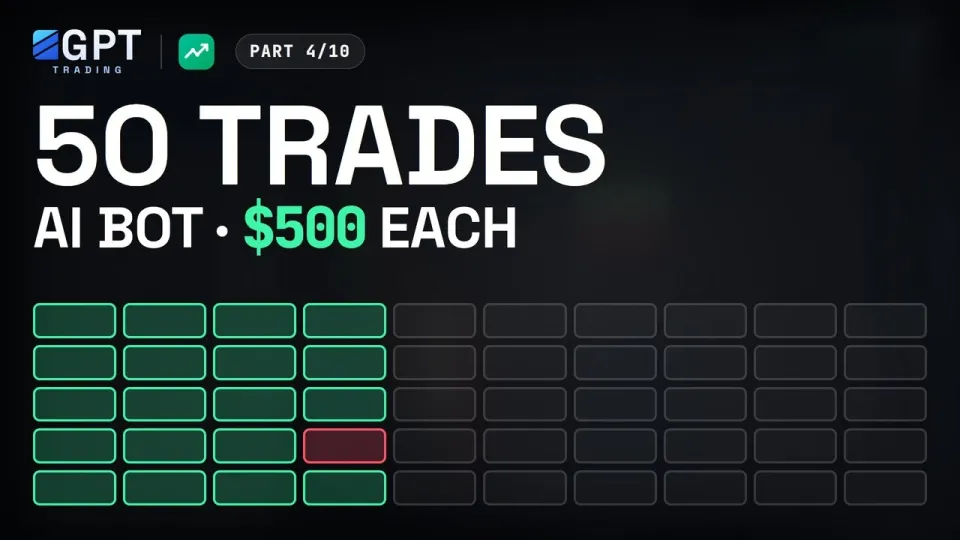
- Trade 19 closed in the red for −$500, the first loss of the recorded session.
- Trade 20 was the single Martingale step: $1,100 stake, +$1,012 payout.
- Part 4 (trades 16–20) finished with 4 wins and 1 loss, +$1,892.
- Balance moved from $45,175.44 to $47,067.44; the session total reached +$8,792.
- Settings: Gold status, Performance mode, 30s–1M deal time, $500 base stake, one-step Martingale, 50-trade limit.
The first loss of the session came on trade 19, which closed at −$500, and the one-step Martingale immediately answered it: trade 20 was opened with a $1,100 stake and returned +$1,012. That pair of trades is the whole point of part 4 of this 50-trade Pocket Option experiment, and it is also the cleanest illustration of how a recovery step behaves in practice. The bot used here is GPT Trading, which you can test through the free GPT Auto Trading access page before committing real money.
What the first loss looked like inside a 50-trade session
Trade 19 was the first red close in the recorded run, and it cost exactly the base stake of $500. Up to that point the session had been a straight sequence of wins, so the loss is the moment where the mechanics stop being theoretical. In a fixed-stake binary options setup, a $500 loss simply removes $500 from the balance and the next trade starts from the same amount. In a Martingale setup, the loss changes the size of the very next order, and that is the difference this part of the experiment documents.
The timing matters too: trades 16 through 20 all closed between 18:20 and 18:25, so the loss and the recovery happened within a few minutes of each other. There was no manual pause, no restart of the bot and no change of settings between them. The session was configured with a 50-trade limit, and the bot simply continued down the list.
How one step of Martingale changes the next trade
A one-step Martingale means the bot is allowed exactly one recovery attempt after a loss, not an unlimited doubling chain. The rule is simple arithmetic: after a losing trade, the next stake is increased so that a win returns the lost amount plus the normal profit. In this session the base stake was $500 and the recovery stake was $1,100, which is slightly more than double, a common adjustment that accounts for the payout percentage being below 100%.
What the numbers show:
- Trade 19 lost $500 at the base stake.
- Trade 20 was opened at $1,100, the single permitted Martingale step.
- Trade 20 won and paid +$1,012, which covered the $500 loss and left a net gain for the pair.
- If trade 20 had also lost, the one-step limit would have stopped the escalation and the bot would have returned to the $500 base stake.
That last point is the part beginners usually miss. A one-step Martingale is not the same as the classic doubling sequence that can run five or six levels deep; the maximum exposure on any single recovery here was $1,100, not a multiple of it.
Part 4 results: 4 wins, 1 loss, +$1,892
The five trades in this segment produced four wins and one loss for a net of +$1,892. The balance moved from $45,175.44 to $47,067.44, which brought the running session total to +$8,792. Those figures are the raw output of the recorded run, not an average or a projection.
The session settings behind those numbers were: Gold status, Performance mode, deal time between 30 seconds and 1 minute, automatic currency pair selection, a $500 trade amount, one-step Martingale, and a 50-trade cap. Nothing was adjusted between trades, which is what makes the segment comparable to the earlier parts of the marathon.
Why the Gold tier matters for automated risk management
Gold status is not cosmetic in this setup. Once a Pocket Option balance is above $300, Gold activates automatically and unlocks automated risk management along with Performance Mode, and on Gold there are no deal limits. That is what allows a 50-trade session to run without the bot stopping partway through.
The workflow is deliberately short: choose the trade mode, the deal time, the currency pair and the amount, then tap Start Auto Session and the bot opens deals on the linked Pocket Option account by itself. Nothing is configured inside the terminal, everything syncs in the cloud, and the bot cannot operate without the user's permission. For anyone comparing this to manual binary options trading, the relevant difference is that the recovery step is executed at the exact moment the loss is registered, without a human deciding whether to double up.
The risk side of a $500 stake with a $1,100 recovery
A $1,100 recovery trade is real money, and the honest framing is that the pair of trades in this part could have gone the other way. Had trade 20 lost, the segment would have shown a loss of roughly $1,600 rather than a gain, and the one-step rule would have prevented any further escalation. That is the trade-off a Martingale structure makes: it converts a high probability of small wins into a small probability of a large loss.
Binary options are also restricted in some jurisdictions, and results from one recorded session say nothing about future performance. The $8,792 session gain shown here is a fact about this run, not an expected return. Anyone testing the approach should treat the $500 base stake as money they can afford to lose entirely, and should understand that the recovery step doubles the amount at risk on the very next trade.
Where to find the rest of the marathon and the official links
Parts 1 through 3 of the marathon cover trades 1 to 15 and are published in order in the playlist, with parts 5 to 10 following the same five-trades-per-part format. The official resources referenced in the breakdown are:
- Free GPT Auto Trading access: https://gpt-trading.app/landing/go?vid_6VBsYhlTI6Y
- GPT Trading Club, reviews and news on Telegram: https://t.me/gpt_trading_club
- Official website: https://gpt-trading.io
Summary
The first loss of the session arrived on trade 19 at −$500 and was recovered by a single $1,100 Martingale trade that paid +$1,012, leaving part 4 at 4 wins, 1 loss and +$1,892. The balance climbed from $45,175.44 to $47,067.44, taking the running session total to +$8,792 with no restarts and no setting changes. The breakdown was produced by the channel GPT Trading BOT | Pocket Option Auto Trading as part 4 of a 10-part, 50-trade experiment. Readers who want to reproduce the setup can start with the free GPT Auto Trading trial and keep the risk warning in mind: trading involves a risk of loss, and past results do not guarantee future performance.
Source: The First Loss: AI Bot Martingale on Pocket Option ($500 Trades) | Part 4/10 · Markdown version
Questions & answers
How much did the first losing trade cost in this session?
Trade 19 closed at −$500, which was exactly the base stake used throughout the session. It was the first red trade in the recorded run, and it triggered the single Martingale step on the following trade.
What is a one-step Martingale in this bot's settings?
The bot is allowed exactly one recovery trade after a loss, with the stake raised to cover the loss plus profit. Here the base stake was $500 and the recovery stake was $1,100, which returned +$1,012. If the recovery trade had also lost, the bot would have returned to the $500 base stake instead of escalating further.
What was the result of part 4 of the 50-trade marathon?
Trades 16 to 20 produced four wins and one loss for a net of +$1,892. The balance moved from $45,175.44 to $47,067.44, bringing the session total to +$8,792.
What do you need to unlock automated risk management and Performance Mode?
A Pocket Option balance above $300 activates Gold status automatically, which unlocks automated risk management and Performance Mode and removes deal limits. The session also used a 30-second to 1-minute deal time, automatic pair selection and a $500 trade amount.